






IAA MOBILITY Weekly
The Mobility Highlights of Week 44/2026
Volkswagen Group China, Mercedes-Benz, electronica 2026
- IAA MOBILITY Weekly
- 44/2026

Volkswagen Group China unveils VEGA technology platform with 850-volt technology and AI-powered driver assistance, Mercedes-Benz to introduce point-to-point driver assistance in Germany starting in 2027, and IAA MOBILITY and electronica 2026 continue their partnership – these are our top news stories for week 44 of 2026.
Volkswagen Group China unveils VEGA technology platform with 850-volt technology and AI-powered driver assistance, Mercedes-Benz to introduce point-to-point driver assistance in Germany starting in 2027, and IAA MOBILITY and electronica 2026 continue their partnership – these are our top news stories for week 44 of 2026.
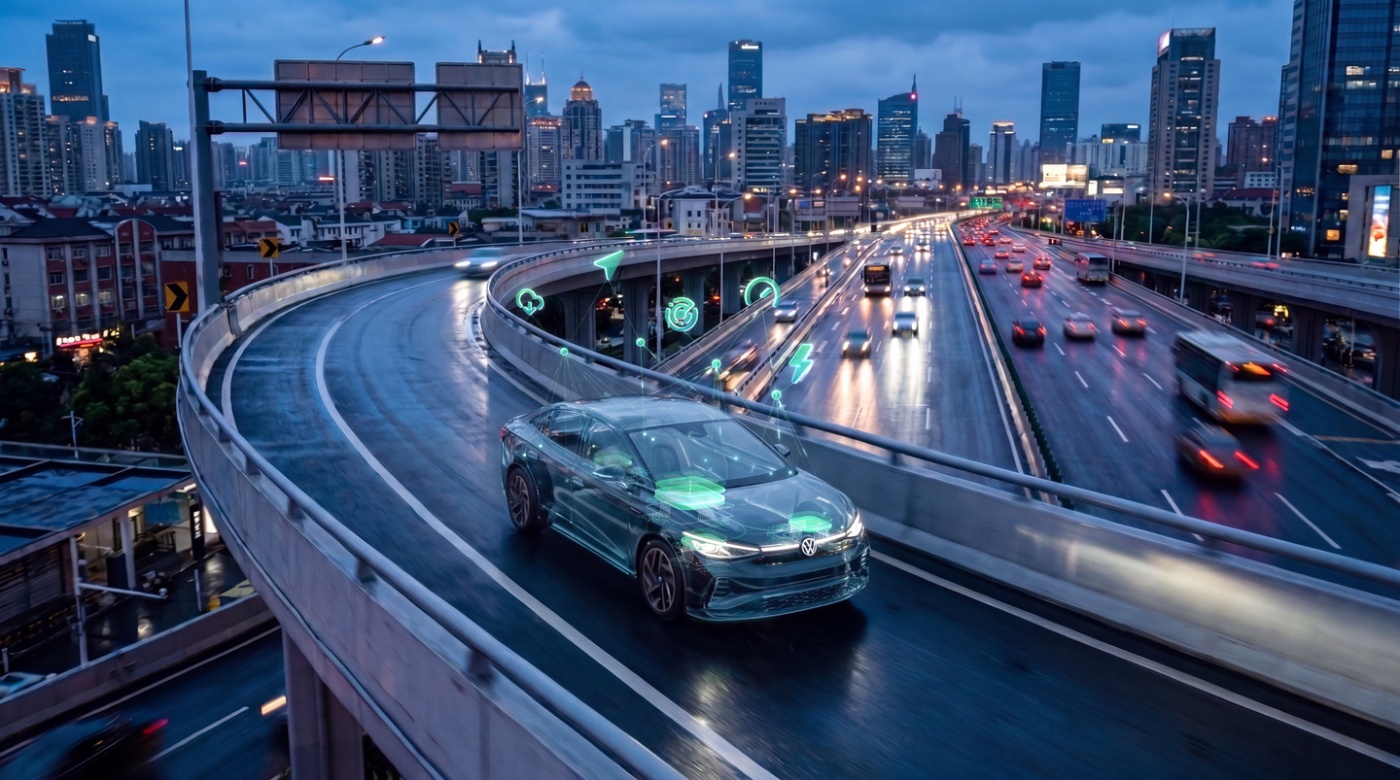
Volkswagen Group China unveiled its new VEGA technology platform at its Tech Day in Hefei, China. The platform combines the locally developed Compact Main Platform (CMP) and China Scalable Platform (CSP) with the centralized China Electronic Architecture (CEA) and AI-powered advanced driver assistance systems. The CMP is designed to enable electric vehicles to achieve a range of more than 600 kilometers under the CLTC test cycle. The larger CSP platform is designed for electric vehicles with a range of more than 800 kilometers and range-extended models offering a total range of more than 1,500 kilometers. Thanks to a high-voltage architecture with a peak voltage exceeding 850 volts, the battery is expected to charge from 10 to 80 percent in just 13 minutes.
With its China Electronic Architecture, Volkswagen aims to accelerate the development of software-defined vehicles. The architecture is scheduled to be introduced in five locally produced electric vehicles in 2026, including the ID. UNYX 06, ID. UNYX 07, ID. ERA 5X, ID. AURA T6, and ID. AURA L5. Volkswagen's AI-powered C-Brain toolchain is expected to reduce software testing times from up to three days to just two to three hours. The company also plans to introduce regular software updates every three months and is developing CEA 3.0, a more AI-driven architecture designed to support SAE Level 4 automated driving functions by 2029.
At the same time, Volkswagen is developing Hyper Sense 8 (HS8), an AI-powered driver assistance system designed to support navigation-based driving functions on highways and in urban environments. By 2027, the company aims to establish the technical capabilities required for SAE Level 3 automated driving. To support development, Volkswagen uses its GAIA 2.0 AI world model, which is designed to simulate traffic scenarios equivalent to approximately five million kilometers of daily driving. As part of its "In China, Beyond China" strategy, Volkswagen also intends to expand the use of technologies developed in China to international markets. South America is expected to become the first region outside China to receive vehicles based on the CMP platform and CEA electronic architecture before the end of the decade.
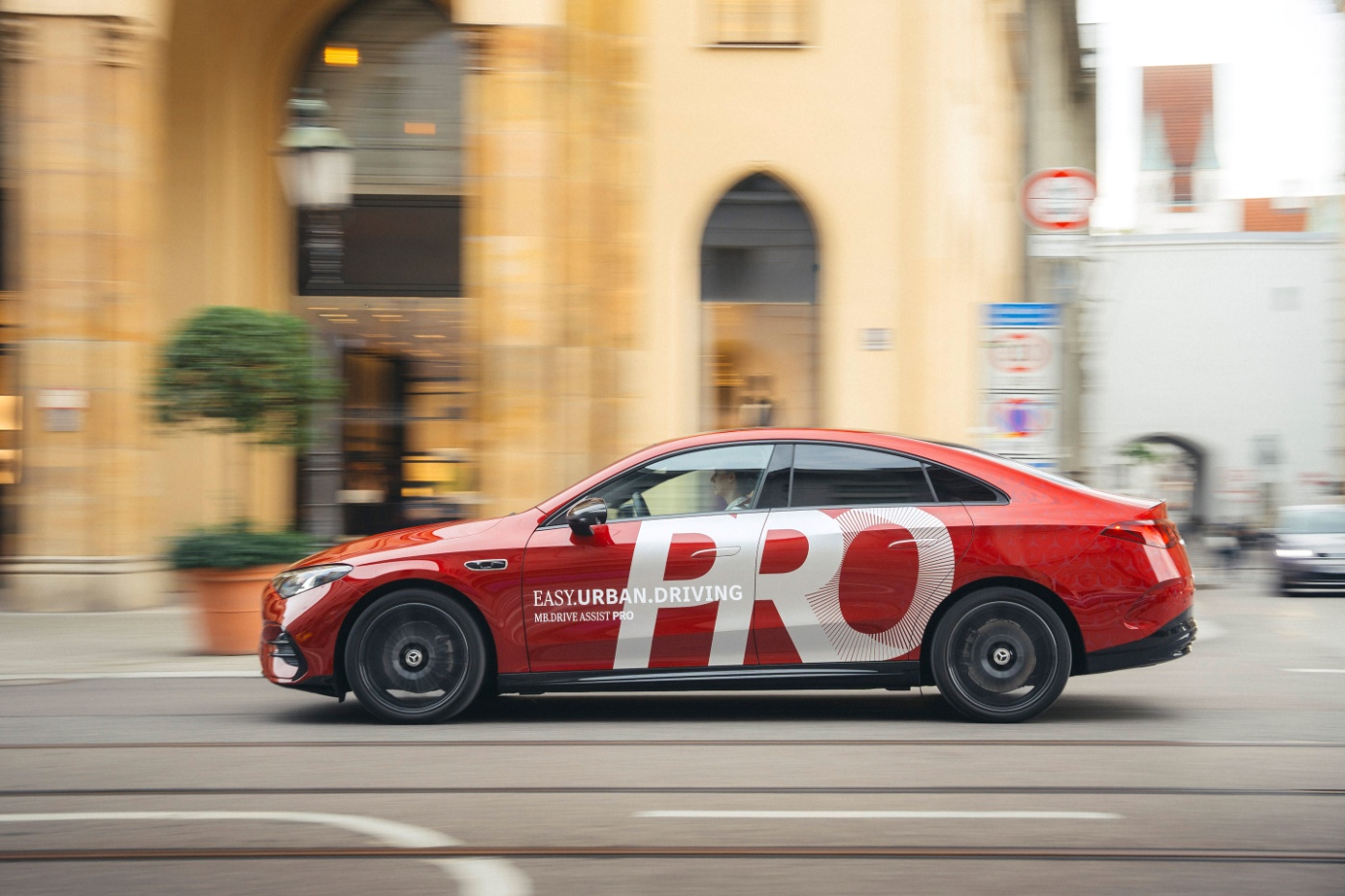
Mercedes-Benz plans to launch its MB.DRIVE ASSIST PRO driver assistance system, developed in collaboration with NVIDIA, in Germany in the first half of 2027. The technology provides continuous driving assistance along a navigation route and is designed to handle complex traffic situations in urban environments as well as on highways. The system assists with lane changes, turning at intersections, merging into traffic lanes, and braking and accelerating at traffic lights. MB.DRIVE ASSIST PRO is classified as an SAE Level 2 system, meaning drivers must continue to monitor traffic at all times and remain responsible for operating the vehicle.
The technology is built on the Mercedes-Benz Operating System (MB.OS) and various NVIDIA technologies. A total of 27 sensors, including ten cameras, five radar sensors, and twelve ultrasonic sensors, monitor the vehicle's surroundings. The data is processed by a high-performance computer delivering up to 254 TOPS of computing power. The system incorporates NVIDIA's Hyperion architecture, the Alpamayo Stack software platform, and the NVIDIA Halos safety system. A cooperative steering concept also allows drivers to intervene and take control of the vehicle at any time.
A limited early-access program is scheduled to launch in the German cities of Stuttgart and Munich in late 2026. Selected customers with appropriately equipped vehicles will be able to activate the system through an over-the-air update. The official market launch is planned for the first half of 2027. Compatible existing vehicles are also expected to receive the new assistance features through software updates. Mercedes-Benz additionally plans to offer a free one-month trial, allowing customers to test the system.
IAA MOBILITY and electronica 2026 are continuing their partnership, which began in 2025 when electronica curated a session on the Main Stage of the IAA Conference at IAA MOBILITY 2025.
As a Premium Cooperation Partner of the world's leading electronics trade show, IAA MOBILITY will host its own program block at electronica 2026 in Munich on November 11, 2026, from 2:30 to 5 p.m. on the Smart Mobility Stage in Hall B4. The program will focus on chiplets as a key technology for the future of mobility. These modular semiconductor architectures are designed to enable more powerful, scalable, and efficient computing systems and are becoming increasingly important for software-defined, connected, and AI-powered vehicles.
The program will begin with the IAA MOBILITY Deep Dive Session, "Innovation in Motion – Reshaping the Future of Automotive Compute with Chiplets," from 2:30 to 3:15 p.m. Michael Schaffert, Senior Vice President at Bosch; Matthias Kiening, Vice President Advanced Electronics and Semiconductor Solutions at Aumovio; Bernhard Rill, Director Physical AI GTM EMEA at Arm; and Frank Hansen, Director European Sales at Tenstorrent, will share insights into how chiplet-based architectures, new interconnect technologies, and the integration of different semiconductor components could transform the development of future automotive computing systems. The session will be moderated by Alexander Sack from STARTUP AUTOBAHN powered by Plug and Play. Before the discussion, Michael Bauer from the German Association of the Automotive Industry (VDA) will provide a brief introduction to the topic.
The panel discussion, "Chiplets in Europe's Semiconductor Future: Innovation, Collaboration and Competitiveness," will follow from 3:15 to 4 p.m., exploring the opportunities and challenges facing Europe's semiconductor industry. Confirmed panelists include Alexander Maier, Head of Department for Semiconductor Standards, AVT, Connectivity Technologies and EMC at BMW; Michael Schaffert from Bosch; Matthias Kiening from Aumovio; Bernhard Rill from Arm; and Manuel Botija, Vice President Product Management at Axelera. The discussion will focus on technological innovation, cross-industry collaboration, and the competitiveness of Europe's semiconductor industry. A networking reception from 4 to 5 p.m. will provide an opportunity to connect directly with the experts.