


Mobility
Kiel Researchers Develop "Talking Battery" for Smarter Battery Management
Image: (c) Uni Kiel
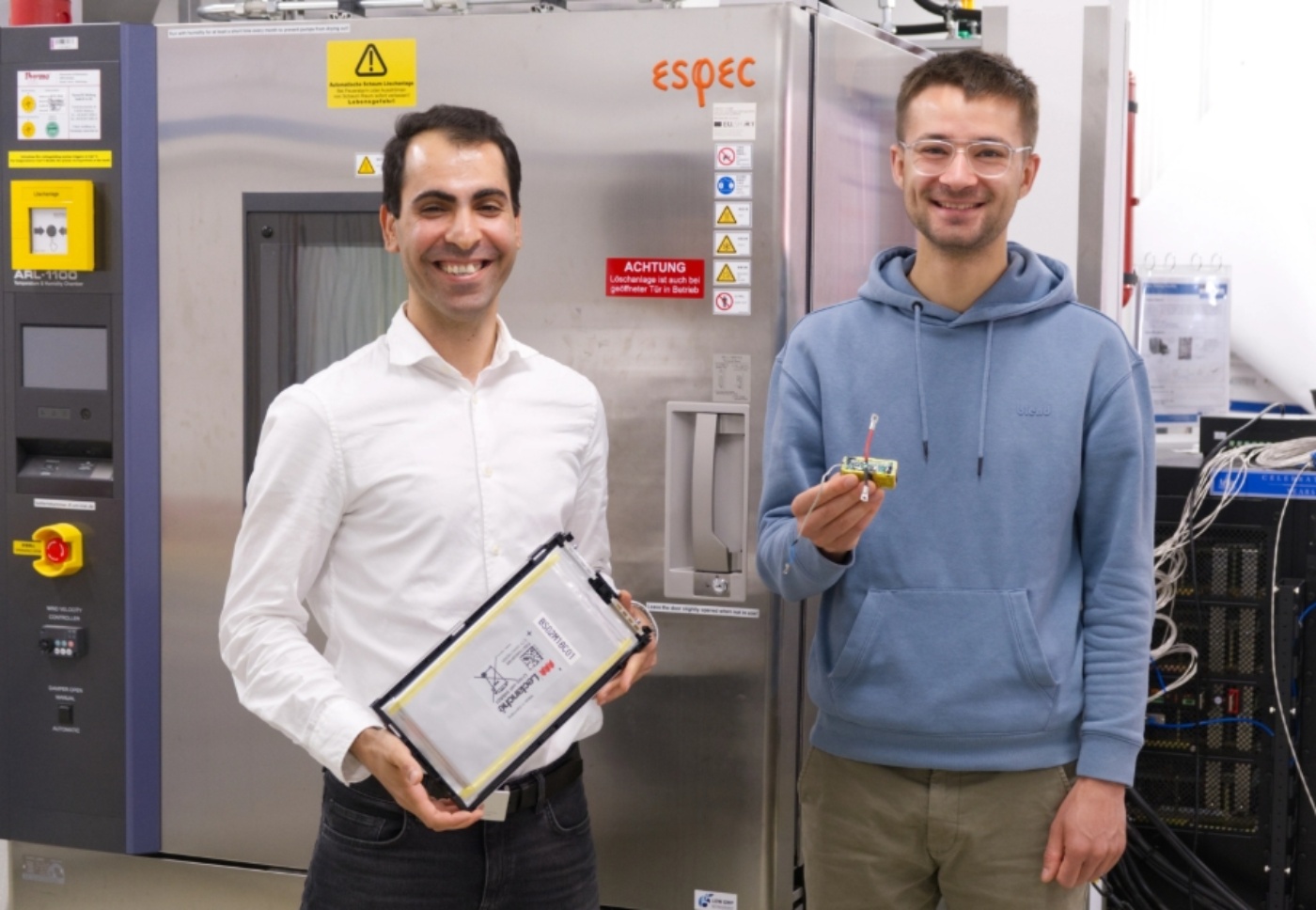
Researchers at Kiel University (CAU) have developed a new communication system for batteries that connects sensors inside a battery cell directly to the vehicle's electronics without the need for additional data cables. The concept behind this so-called "talking battery" aims to make battery management systems simpler, more cost-effective, and ultimately safer in the long run.
Until now, battery management systems have primarily measured temperature using sensors on the outside of the battery cells. However, critical temperature spikes often start inside the cell, where they initially go undetected. While sensors can technically be integrated inside the cell, they have previously required additional electronics and communication lines that take up valuable installation space.
Researchers at Kiel University (CAU) have developed a new communication system for batteries that connects sensors inside a battery cell directly to the vehicle's electronics without the need for additional data cables. The concept behind this so-called "talking battery" aims to make battery management systems simpler, more cost-effective, and ultimately safer in the long run.
Until now, battery management systems have primarily measured temperature using sensors on the outside of the battery cells. However, critical temperature spikes often start inside the cell, where they initially go undetected. While sensors can technically be integrated inside the cell, they have previously required additional electronics and communication lines that take up valuable installation space.
Communication via Existing Power Lines
The Kiel research team is taking a different approach: a small electronic circuit is integrated directly into the battery cell, converting temperature sensor readings into a digital signal. The data is then transmitted through the very same terminals already used for charging and discharging the battery. This completely eliminates the need for extra data cables.
According to the researchers, this method pulls double duty on existing components, making it roughly 35 percent more cost-effective than conventional solutions that rely on separate sensor lines.
The Foundation for Smart Battery Systems
The researchers view this concept as a major step toward smart batteries that continuously monitor their own status and actively provide information on changes inside the cell. In the future, this could make battery systems more reliable to monitor, safer to operate, and more economical.
Looking ahead, the goal is to further miniaturize this communication principle or integrate it directly into new battery materials. In addition to temperature sensors, future applications could use the same method to transmit data from pressure, gas, or other sensors inside the battery.
Potential for Numerous Applications
The research team believes that, over the long term, this process is well-suited for a wide variety of high-performance battery system applications. These include electric vehicles, stationary energy storage systems for wind and solar power, and home energy storage. At the same time, the measurement data gathered from inside the cells could help scientists better understand new battery materials and fast-track their development.