International Day of Persons with Disabilities
“Accessible mobility is essential because it opens pathways to fully participate in public life.”
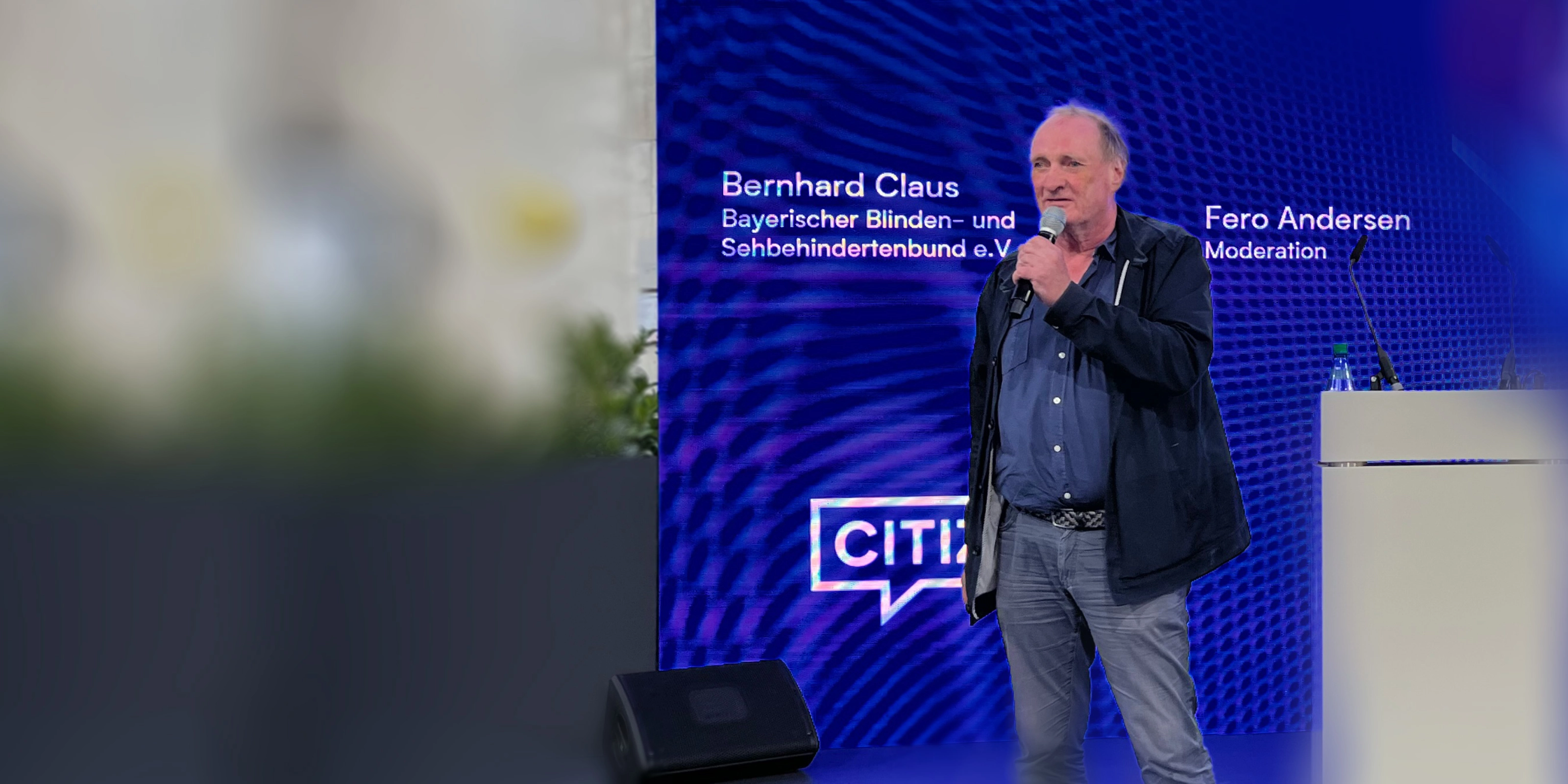
What does mobility feel like when you can’t see? For the International Day of Persons with Disabilities, Claus Bernhard, Accessibility Lead at the Bavarian Association for the Blind and Visually Impaired and Chair of the Mobility Working Group on Munich’s Disability Advisory Council, talks about everyday barriers, successful inclusion efforts at IAA MOBILITY, and why true accessibility is ultimately a matter of respect, equality, and an open society.
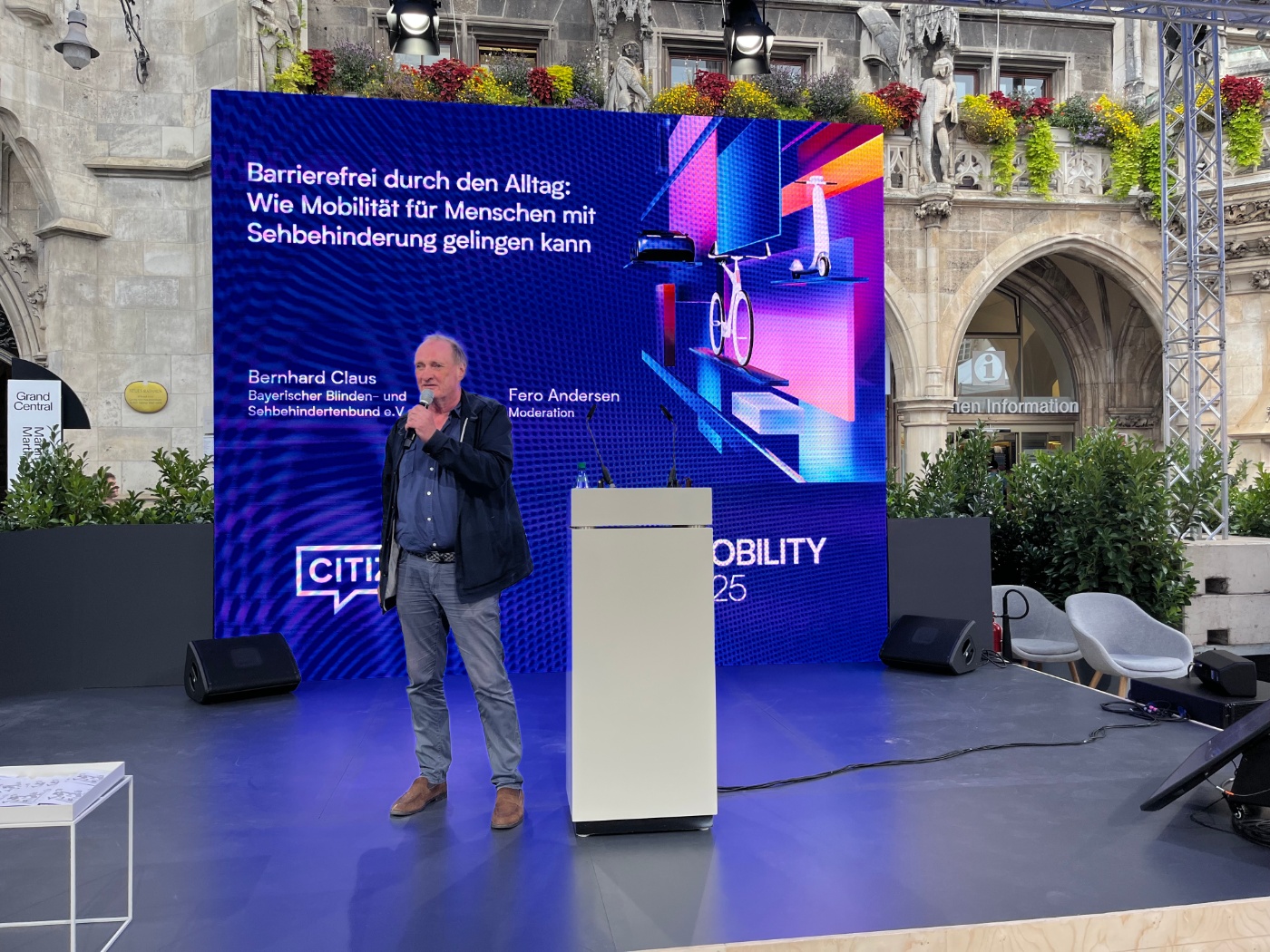
IAA: Hello, Mr. Claus. You are responsible for accessibility at the Bavarian Association for the Blind and Visually Impaired (BBSB e.V.) and you chair the Mobility Working Group within the Advisory Council for People with Disabilities for the City of Munich. What are your core responsibilities in these roles?
Bernhard Claus: In the Working Group, our main tasks involve formulating opinions and statements for the City Council. We either support or object to proposals based on the arguments of accessibility. Additionally, we develop and discuss accessibility standards for the city's built environment. This means that when buildings or streets are constructed, especially with pedestrian crossings, we advise on the design: should they be separate crossings, double crossings, use a tactile warning strip, or utilize traffic lights with orientation and audible release tones — acoustic elements, and so on.
IAA: You are blind yourself. How did you experience accessibility at IAA MOBILITY?
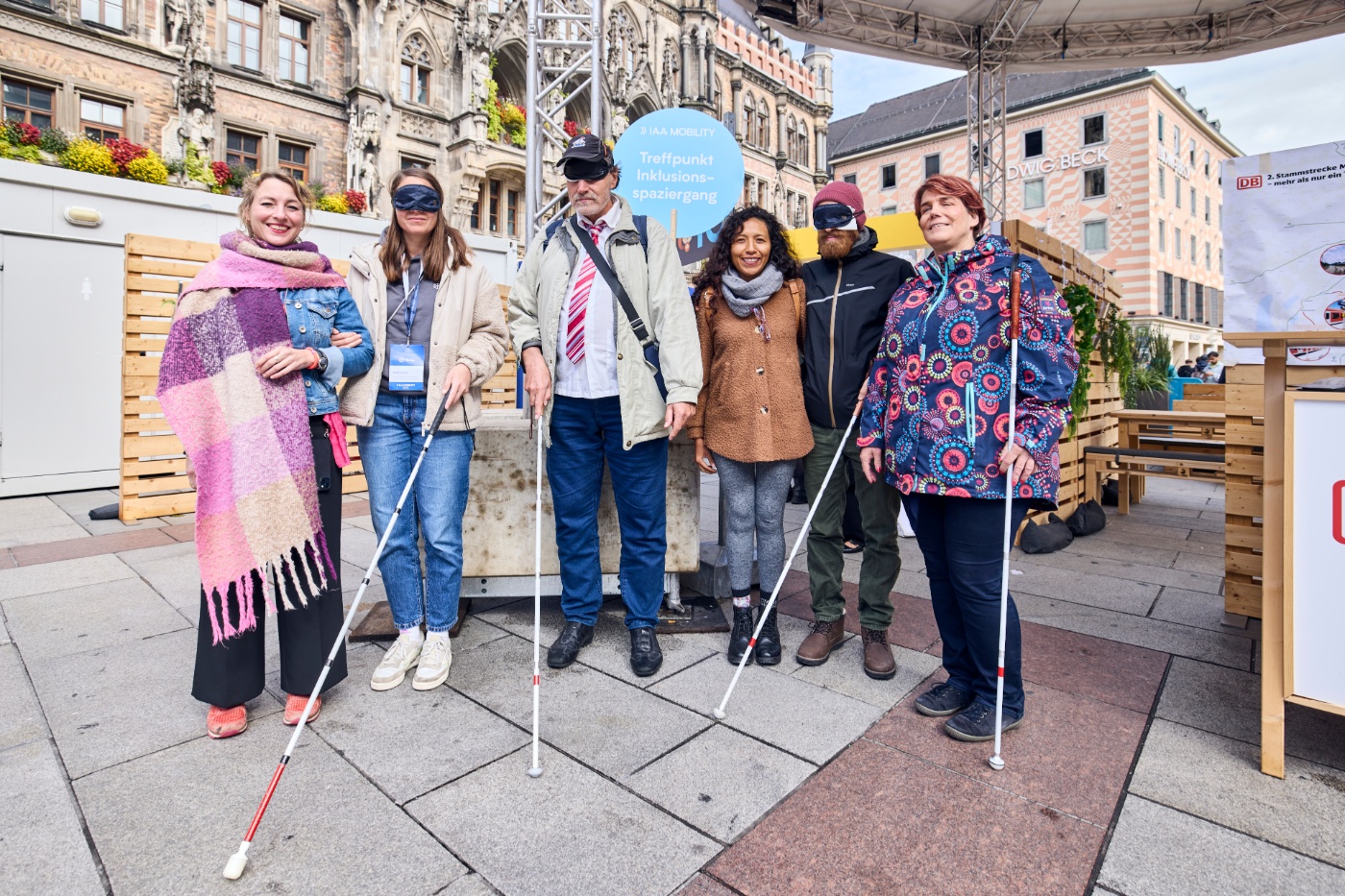
Bernhard Claus: That’s right, I am 100% blind. I participated as a speaker during the IAA MOBILITY’s inclusive tours. The Citizen Lab was nearly fully accessible, and the same goes for Marienplatz. As a wheelchair user, a visually impaired person, or a blind person, you could easily get to where you needed to go. It was also easy to enter many of the auto manufacturers' stands. It was very well done.
IAA: Are there everyday barriers you encounter that you think go completely unnoticed by people without disabilities?
Bernhard Claus: Sidewalk parking is a prime example. I don't believe people think about the implications at all. They park their car on the sidewalk, assuming the pedestrian can just walk around it. What they often fail to consider is that people with limited mobility, like wheelchair users, need much more clearance and space — especially with oncoming traffic.
IAA: How could transportation planning be improved for people with limited mobility?
Bernhard Claus: One improvement that would benefit all road users would be the introduction of dedicated bus lanes, reserved only for public transit and perhaps taxis. I'm not sure if further restrictions should be made between electric vehicles and gas-powered cars. But it’s essential that local public transit (ÖPNV) gets its own lanes. While many people take the subway within the city, if there's a substitute bus service and you must rely on motor vehicle traffic, you often get stuck in traffic jams. Traffic shouldn't constantly impede itself. Therefore, it's crucial to expand public transit infrastructure and make it more appealing.
IAA: For the first time this year, IAA MOBILITY offered inclusive tours in collaboration with the Advisory Council for People with Disabilities, allowing people to experience the city from a new perspective—to feel what it’s like to navigate the area with hearing impairment, visual impairment, or in a wheelchair. What was your impression of these tours?
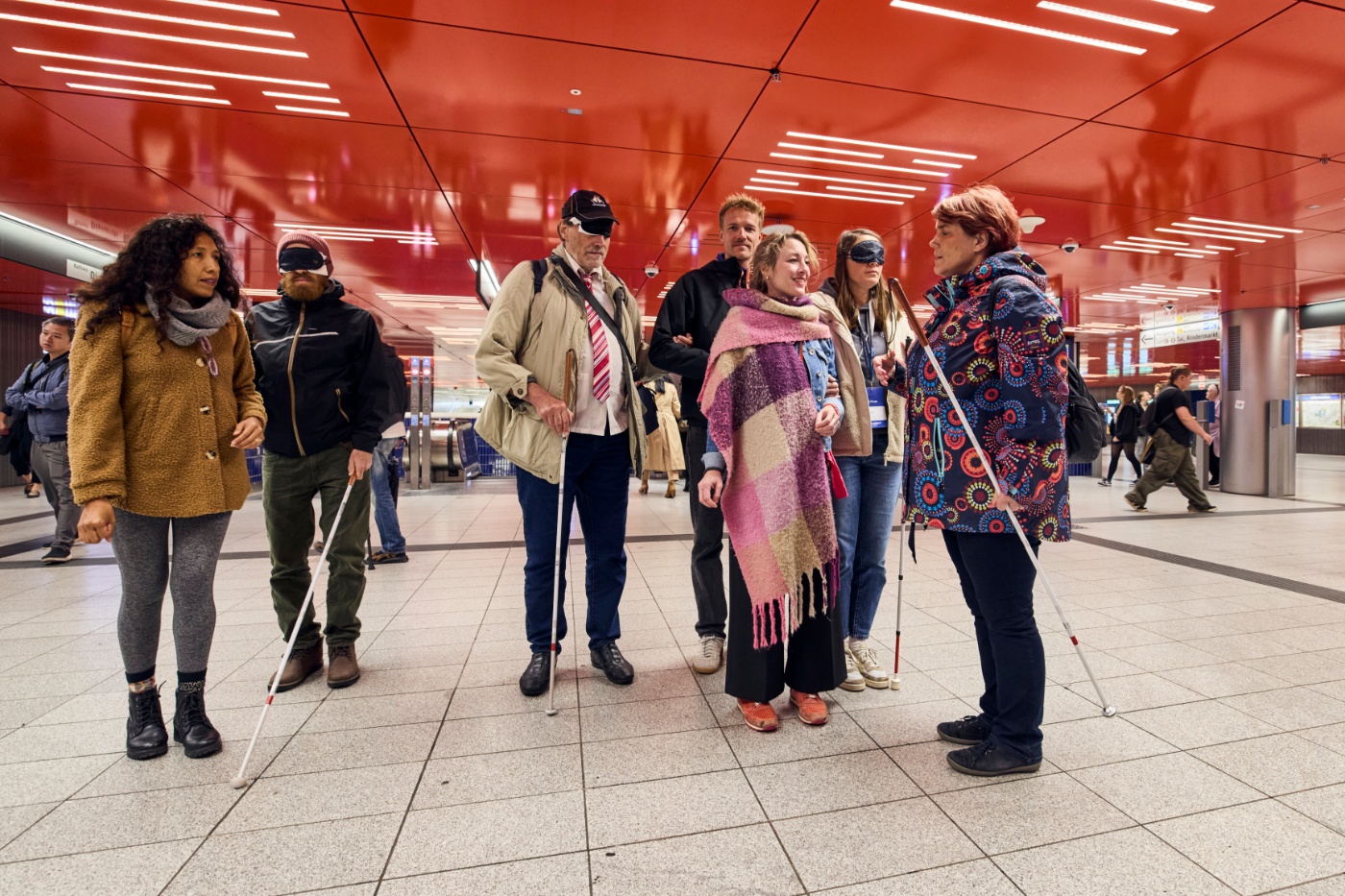
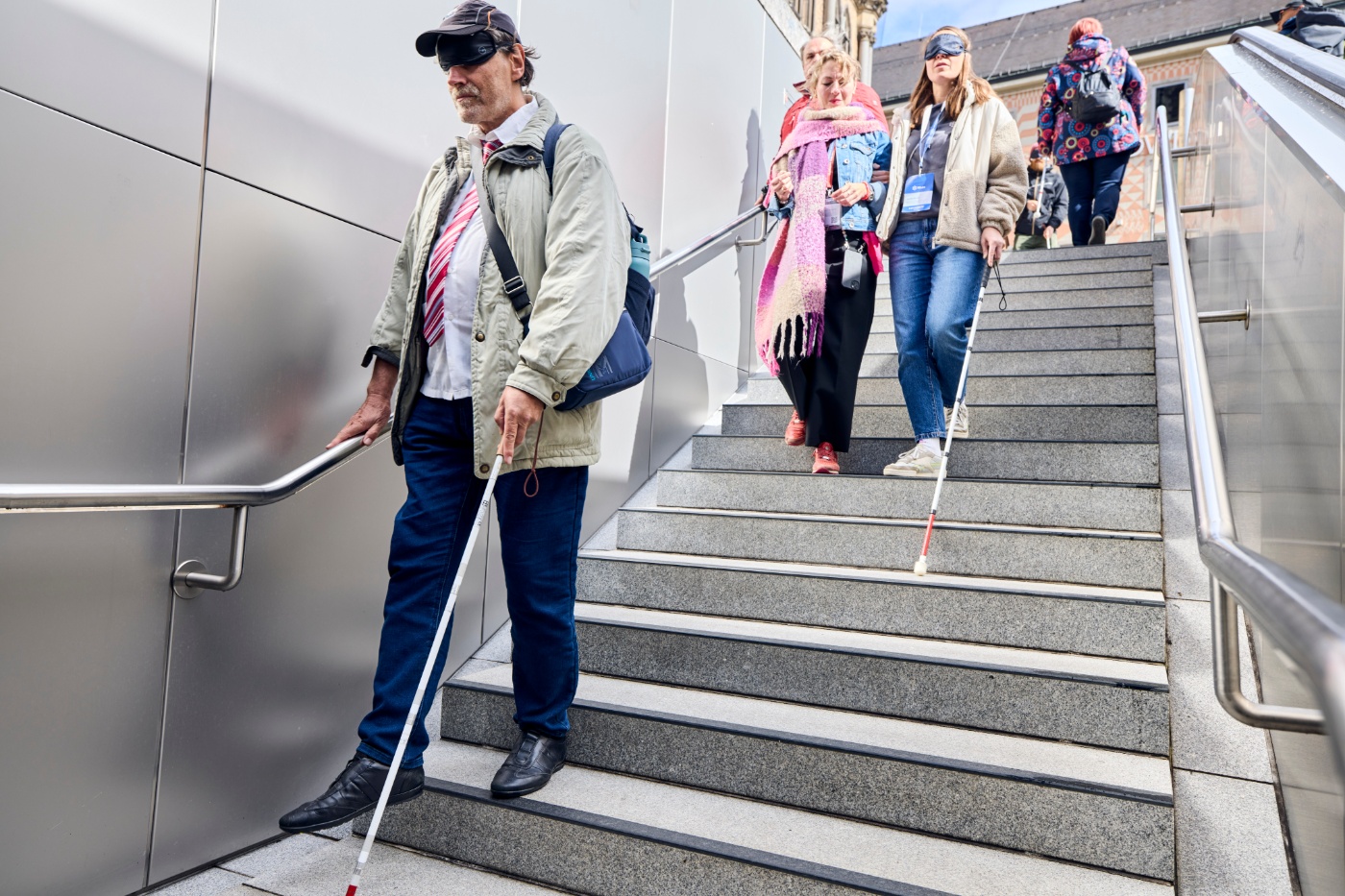
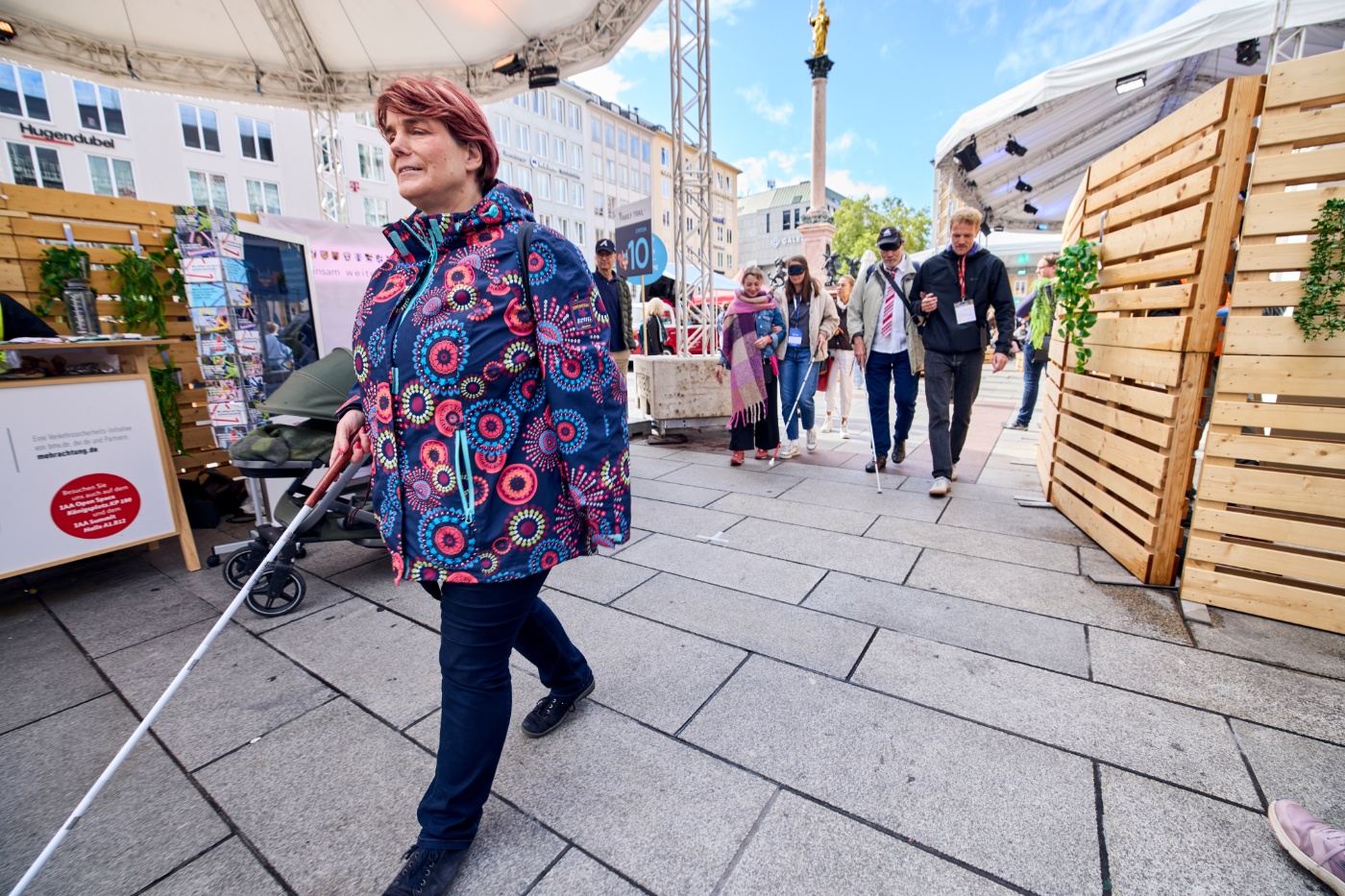
Bernhard Claus: During the inclusive tours at Marienplatz, we demonstrated how to navigate the square and how I get to and ride the subway. I was the speaker for the visually impaired segment, showing people how it works when you can’t see. Under my guidance, participants formed pairs of sighted and non-sighted people. Many were truly astonished by the obstacles visually impaired people face that they’d never considered. For example, the horizontal gap between the platform and the subway car entrance. Or how focused they became on themselves that they completely missed the announcements indicating we had arrived at the Sendlinger Tor station.
Many participants later told me that they now look at the subway or Marienplatz differently when they see people using a long white cane. When people, for instance, jostle and push without being mindful of others, visually impaired people get shoved around. A sighted person can always avoid an obstacle, but someone who is blind or visually impaired cannot.
.jpg)
IAA: What could IAA MOBILITY do to improve accessibility for the next event?
Bernhard Claus: They could make the exhibition even more specifically accessible for people with visual impairments or wheelchair users. For example, they could more clearly showcase everyday vehicles and how they can be adapted. It should be possible to develop a car so a wheelchair user can easily use it — that there's enough space, that they can load the wheelchair from the rear, or that a wheelchair user can transfer behind the wheel and have the wheelchair stored. These are all things that fit into the daily lives of every person.
IAA: What role do digitalization and AI play in accessible mobility?
Bernhard Claus: This is constantly improving. Within cars, we’ve been involved in developments for a long time, such as automatic pedestrian warnings. We also see technology at signalized intersections (traffic lights) that can extend the walk phase when a person with a disability approaches who needs more time to cross the street.
Artificial Intelligence has also become crucial. I notice this in all the apps I use in my daily life—for example, to identify different types of yogurt. Similarly, AI is used for recognition in public transit, allowing me to see which buildings are in front of me. If I want to go to the Hofbräuhaus, I can take a photo, and the AI can immediately tell me I’m standing in front of it because it recognizes the building. A navigation program will guide you somewhere and say you've reached your destination. A sighted person can see it then. For me, however, if the destination is within a 10-meter radius, it could still be left, right, forward, or anywhere else. With the help of AI, it can pinpoint my location precisely so I can find the entrance. It's certainly great for that.
However, an AI or an artificial device should not be necessary for safety in traffic and crossing the street. It should always be possible to navigate traffic, cross streets, and walk along roads without technology. If technology fails, I can no longer participate in traffic.
IAA: In your opinion, which innovations in the mobility sector would be especially helpful for blind people or other people with disabilities?
Bernhard Claus: Good navigation systems. For example, a system that allows me to walk from the train station to the Münchner Freiheit. I would input the destination, and the system would tell me to take the S-Bahn to Marienplatz, then transfer to the U-Bahn (subway). And, crucially, that it can describe exactly where I need to walk at every location. This isn't always possible yet. As soon as I go underground, GPS stops working, so the system would need to switch to an alternative.
If I enter 'Münchner Freiheit' at the station, I would love something that tells me to go straight, then down the stairs on the left, then straight again, guiding me all the way to the S-Bahn. I wish for navigation that guides you comprehensively.
A sighted person simply looks at Google Maps and uses the signage in the station to quickly find the subway. As a blind person, I need a detailed description because I can't see those signs; I can’t follow them.
IAA: How crucial is it to increase awareness of accessible mobility?
Bernhard Claus: Designing accessible mobility is extremely important because these are the pathways to getting around and participating in public life — going to the theater and cinema, visiting friends, or going shopping. That is all public life, and if I can’t do it accessibly, then I won’t do it. I’ll stay home and become isolated. This, unfortunately, happens to many people because they can't navigate the world outside.
That’s why it’s vital for the environment to be accessible; everyone may need it someday. As you get older, your vision automatically declines, and you need the assistance that you didn’t require when you were young and healthy. Therefore, it is important to create accessibility, because then everyone can participate in life as they want and are able to, without constantly having to rely on other people to help them be part of the community.
Moreover, a stroke of fate can affect anyone. I was blinded from one day to the next at age 22 in a motorcycle accident. You have to overcome that psychologically first, and then you eventually have to develop the skills to use the available assistance and what you can do yourself. Through mobility training and rehabilitation, you learn to do some things, or many things, again.
IAA: Final question: On a day like the International Day of Persons with Disabilities, what message do you have?
Bernhard Claus: I would be happy if everyone could look beyond their own horizon — and actually do it. Don't just see your own problems, but especially those of the most vulnerable people: people with disabilities, people with limited mobility. That you see these people, acknowledge their issues, accept them, and also do something about them. And that you follow the rules of the road. For example, don’t park on sidewalks, and e-scooter riders shouldn't abandon their e-scooters on the pavement, and so on. Always think of the other person, even if you think, "This is no problem for me," it could be a problem for someone else. That is what I would wish for. More openness, more visibility for things that don't directly affect you.