

Technology
"HV-MELA-BAT" Project Develops High-Efficiency Charging System
Image: (c) FraunhoferISE
The research project "HV-MELA-BAT" is making significant strides in the development of high-performance charging infrastructure for battery-electric heavy-duty and passenger transport. Led by the Fraunhofer Institute for Solar Energy Systems ISE, the project has produced a megawatt-scale charging system that combines high power output with exceptional efficiency and improved grid compatibility.
The research project "HV-MELA-BAT" is making significant strides in the development of high-performance charging infrastructure for battery-electric heavy-duty and passenger transport. Led by the Fraunhofer Institute for Solar Energy Systems ISE, the project has produced a megawatt-scale charging system that combines high power output with exceptional efficiency and improved grid compatibility.
At the core of the project is the evolution of the existing Combined Charging System (CCS) into the new Megawatt Charging System (MCS). This shift is driven by the growing need for significantly higher charging capacities, particularly in the heavy-duty sector. The project team developed essential components for this transition, including grid-side rectifiers, modular DC/DC converters for voltage adjustment, and a contact system designed for high currents and voltages. The system is flexible and engineered to support various vehicle types and voltage ranges.
Buffer Storage Enables High Power Despite Limited Grid Connection
A key feature of the system is an integrated buffer storage unit made from second-life electric vehicle batteries. This unit is designed to reduce the required grid connection capacity of the charging station to 500 kW while smoothing out peak loads. During testing, the system successfully demonstrated a charging capacity of over one megawatt, with the buffer storage providing the additional power required beyond the grid's limit.
Record-Breaking Efficiency and Power Density
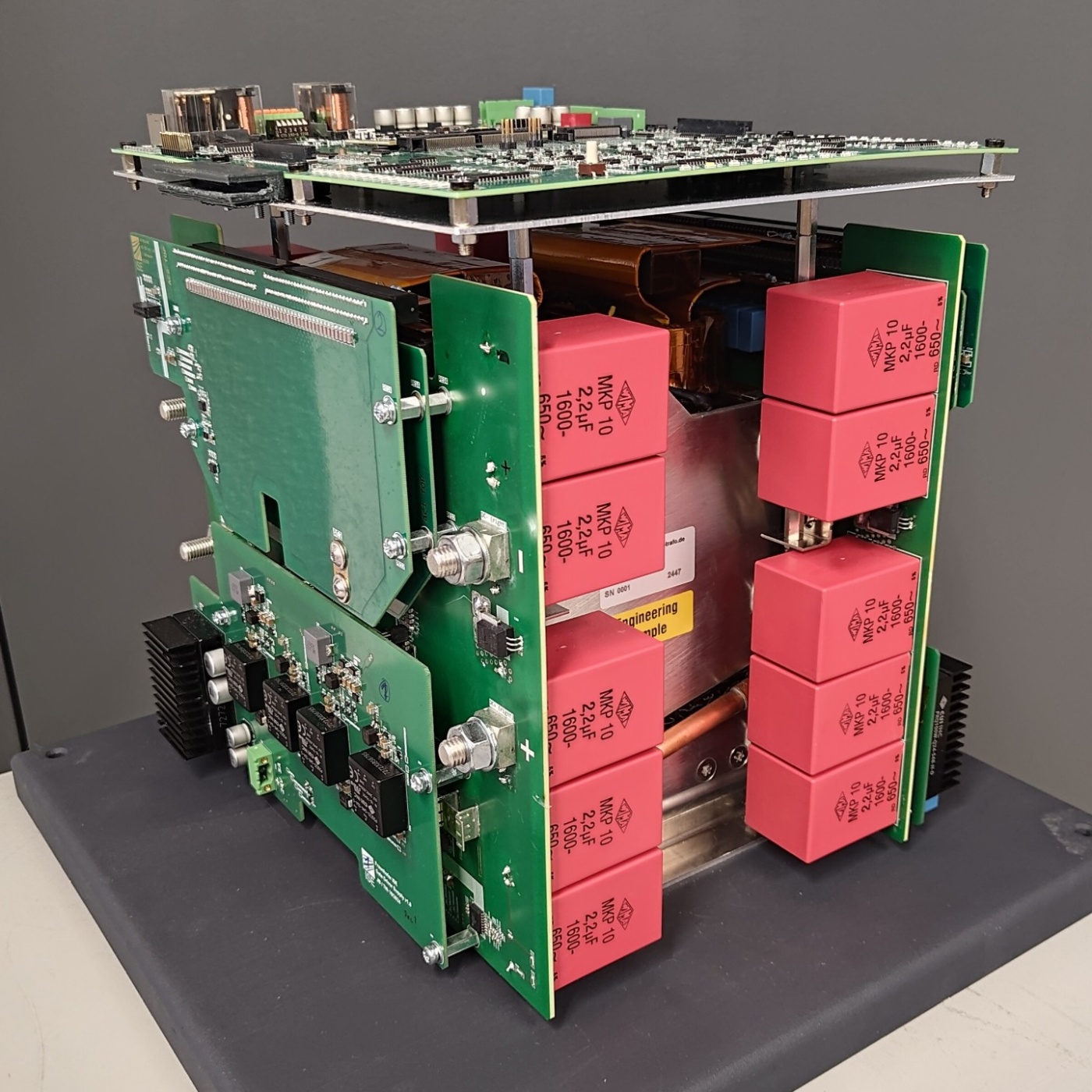
A technological highlight of the project is a newly developed, galvanically isolated DC/DC converter with a 250 kW output. Four of these modules are combined to achieve the full megawatt charging capacity. By utilizing a very high switching frequency of up to 200 kHz, the converter achieves a volumetric power density of 9 kW per liter and a world-class efficiency of 99.26 percent.
Flexible System with Renewable Energy Integration
The charging system features a modular design, allowing it to adapt to various operational scenarios. In addition to powering multiple charging points—such as four connections at 250 kW each—the project also explored the integration of renewable energy sources. For example, solar power can be used directly for charging or stored temporarily in the buffer unit.
Successful Demonstration in the Multi-Megawatt Lab
The complete system was built and tested at Fraunhofer ISE's Multi-Megawatt Lab. These tests successfully demonstrated the combination of high charging power, limited grid connection requirements, and superior efficiency. Various charging profiles and storage sizes were evaluated, showing consistently high efficiency levels across the entire energy chain. In addition to Fraunhofer ISE, industry partners such as Mercedes-Benz Energy were involved in the project, which received funding from the Federal Ministry for Economic Affairs and Climate Action.